

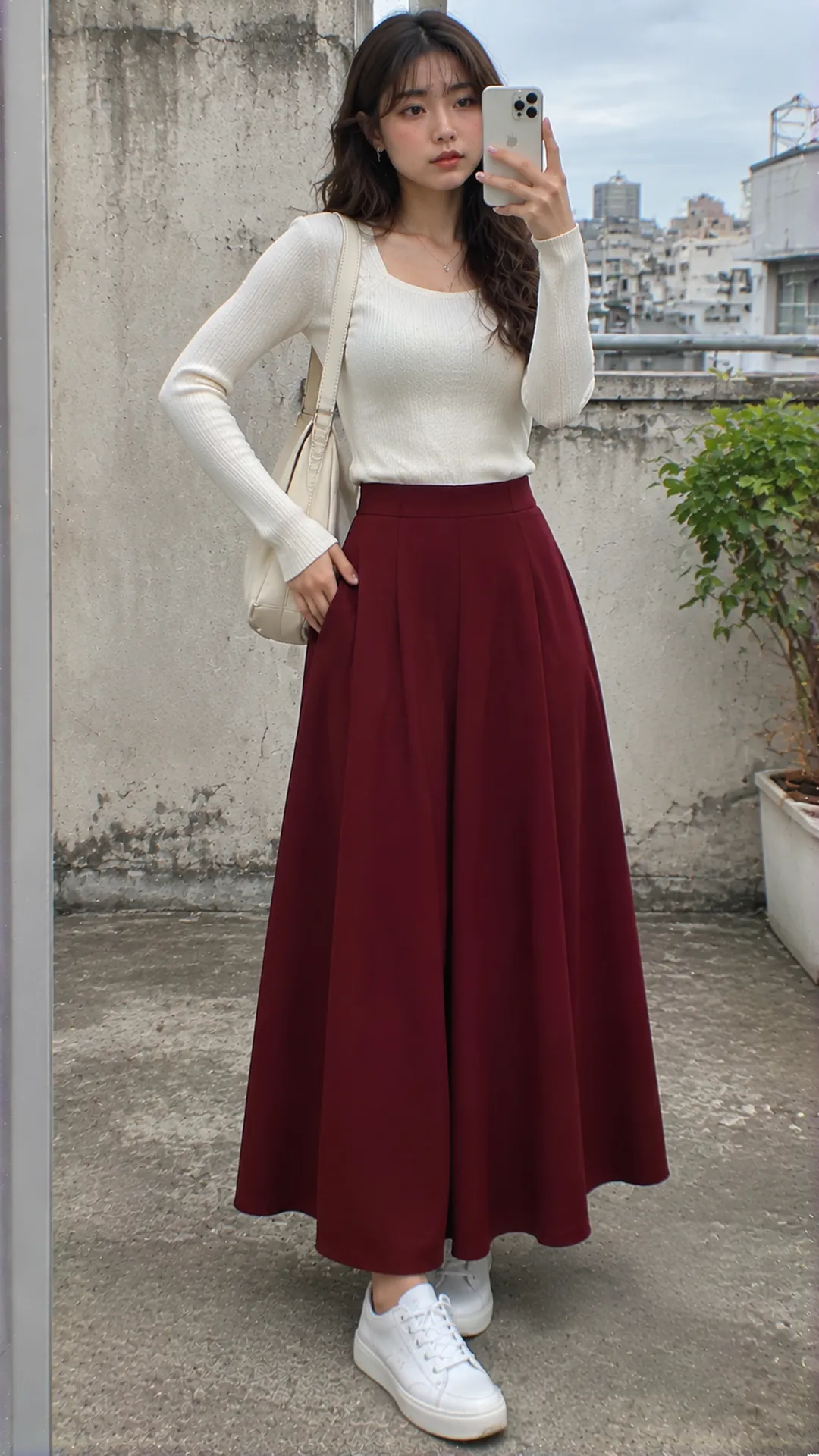
Identify the shade of burgundy and the skirt’s role
A burgundy skirt may lean brown or purple, or look distinctly red outdoors. Hold it beside a white top to judge how dark it is and where the color leans. Choose what brings out the shade you like.
Decide whether you want the skirt to stand out, the whole outfit to feel subdued, or the overall look to be brighter. A simple top keeps attention on the skirt. For a dark palette, use a different fabric finish or neckline to distinguish the pieces.
A mini, pencil skirt, and long flared skirt in the same burgundy each work with a different amount of volume up top. Check width, length, and the waistband before ruling out a color.
If you’re weighing several options, our guide to creating a fashion mood board helps you gather references by color, silhouette, and occasion. Use them to see what you like, then test the idea with your own clothes.
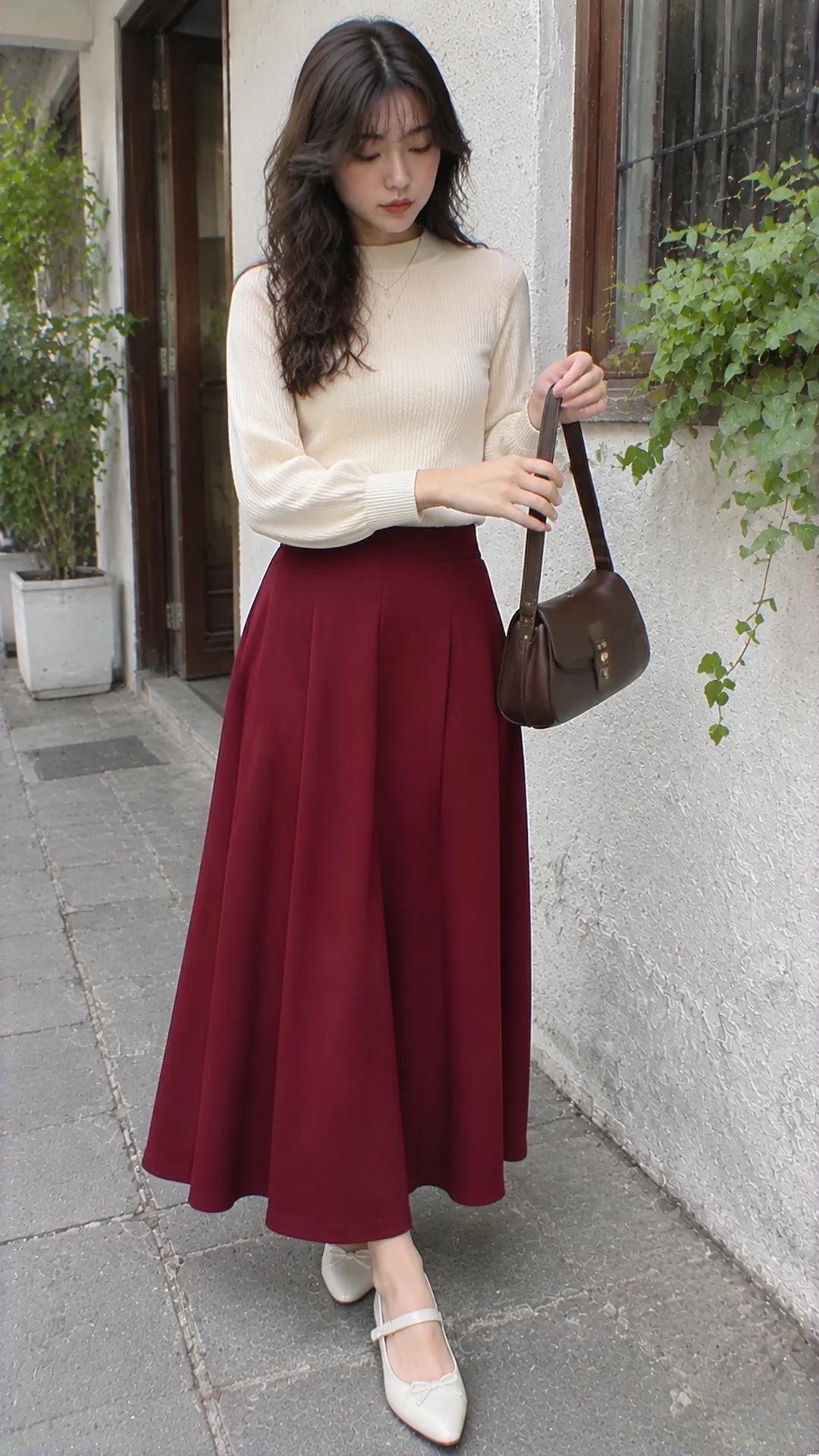
White and cream for a lighter top half
White gives the skirt a clear edge
White and burgundy create two distinct blocks of color. A white tee and A-line skirt work for a casual look. A white button-up and straight skirt give more structure. How you tuck the top and how wide the sleeves are change the effect even when both tops are white.
If the top is thin, check its opacity in bright light with the layer you plan to wear underneath. Choose a base layer that stays comfortable without repeated adjustment or a jacket to keep it covered.
With a long skirt, try a white top that ends near the waistband or tuck it in neatly. Leaving it out can give a relaxed silhouette. Check how much of the skirt still shows, since a very long top can leave only a strip of burgundy visible.
Cream softens the transition
Cream or ivory usually gives a gentler contrast against a deep shade than bright white. Try a cream blouse with matte burgundy or a fine knit with a slightly glossy skirt. The difference in finish helps each piece stand out.
Cream can lean strongly yellow or sit closer to white. If the pairing feels off, try a different undertone within the same color family and check it in the lighting where you’ll wear it most.
Gray and black for a muted palette
Light gray makes burgundy stand out with less contrast than white. Try a pale gray button-up, burgundy pencil skirt, and simple shoes for a suitable setting. Keep accessories in a limited palette to see how the two main pieces work together.
Mid-gray or charcoal deepens the palette. The neckline, sleeves, and waistband then help separate the two blocks. If both pieces are roomy, try a slimmer cut on one to give the outfit shape before adding brighter accessories.
A black top lets burgundy be the only distinct hue. A black tee, short skirt, and boots give a different effect from a black square-neck top and midi skirt. Choose the cut for what you’ll be doing and how much coverage you want.
If both pieces are similarly dark, use texture to distinguish them. Try a matte top with a slightly glossy skirt or a finely ribbed top with a smooth skirt. Strong shine on both pieces can shift the focus to several areas at once.
Our guide to choosing and styling skirt silhouettes covers the fitted areas, flare, and hem. Consider those separately from the top’s color.
Denim blue and navy for a change of color
A mid-blue denim shirt gives a burgundy skirt a contrasting surface. If the denim is thick, avoid packing the entire hem into a snug waistband. Try a shorter shirt or wear it open over a simple top when the weather allows.
Matte denim can make a glossy burgundy skirt feel more casual. With a structured skirt, a stiff denim shirt adds volume. If the outfit feels too rigid, try a softer top before changing the color.
Navy and burgundy make a dark palette with two distinct hues. Try a simple navy top, a burgundy skirt, and shoes close to one of the colors. Check in low light if clear contrast matters to you, since the two shades may look more similar there.
A plain dark bag can blend in, and a light bag can add a second focal point. Decide how many areas you want to draw attention to before repeating the burgundy in accessories.
Pale pink or related reds for more color
Pale pink and burgundy are related in hue and differ in lightness. Try a plain blush top with a straight burgundy skirt. If the top has a bow, the skirt has ruffles, and the bag has a pattern, the amount of detail can shape the look as much as the pink itself.
Gray-toned pink and bright pink give different effects. Hold both next to the skirt and step back. Choose the one that fits your taste and the occasion.
A top close to burgundy creates a tonal outfit. Two near matches can look accidental when the difference is slight. For a more deliberate effect, choose a visible difference in lightness or surface.
A matte deep-red top and a slightly glossy burgundy skirt use texture for emphasis. A brighter red top draws the eye upward. Choose the piece you want people to notice first.
Turn the colors into three wearable outfits
A light, simple outfit for a busy day
Start with a burgundy A-line skirt, cream tee, sneakers, and a plain bag. Adjust the tuck so the waistband sits smoothly, then sit and walk. Choose a bag that fits what you need to carry and work its color into the outfit afterward.
A defined silhouette for meeting someone
A straight burgundy skirt, light gray button-up, and simple shoes make distinct blocks. Try small earrings or a watch, and keep the neckline simple if the collar already stands out. Try on your jacket to check for room at the arms and shoulders.
A dark outfit for evening
A black top with a neckline you like, burgundy skirt, and dark shoes create a subdued base. Metal hardware on a bag or a pair of earrings can add a bright detail. If the skirt is glossy, try wearing it with less metal to see how much the fabric already stands out.
Our guide to statement accessories for women explains how to place accents near the face, waist, and hands. One accessory can be enough if it serves the outfit.
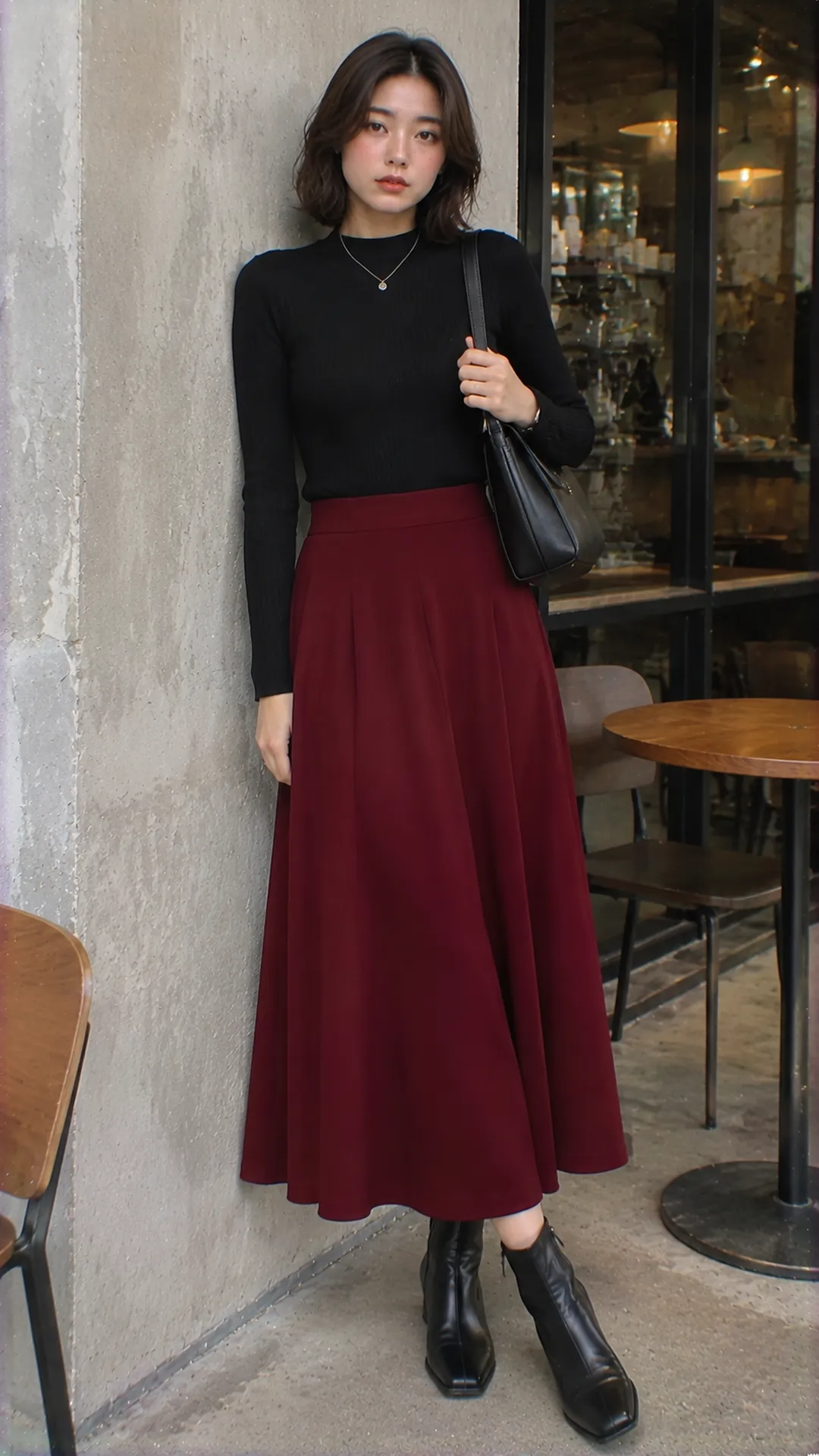
Try on the outfit to find what needs adjusting
Keep the skirt and try a light top, a dark top, and a colored top in turn. Photograph each from the same place in the same light while standing naturally. Compare where the pieces meet, how much the burgundy stands out, and the overall effect. Keep your shoes, hairstyle, and bag the same for a fair comparison.
If all three tops make the outfit feel heavy, check the length and amount of fabric. If only one feels busy, look at the pattern, buttons, and sleeves. Choose colors using the actual garment when it differs from its product photo.
To build on what you own, see our item-by-item styling guide. Before buying another top, decide whether you need a different color, cut, or fabric. A specific need is easier to check while shopping.
A burgundy skirt can work with several color families. Use lightness, finish, and proportions to narrow down the choices. Keep the outfits that suit your plans and let you move without frequent adjustments.
If the skirt has a slit, gathers, or prominent buttons, check whether the top covers a detail you want to show. A matching top whose hem falls right on the gathers can add unwanted bulk at the waist. Try adjusting the hem or tuck before shopping for a different color.