


Read the material description before considering style
'Silver bracelet' and 'silver-colored bracelet' are not always interchangeable. Surface color does not establish the full material. For plating, ask about both base metal and coating; stones and glued components also require compatible cleaning methods.
Tiffany uses the .925 sterling silver standard and provides dedicated silver-care guidance. A stamp does not replace seller information, an invoice or a material-verification policy, however. Do not judge quality from a close-up of a small mark alone.
Ask specific questions: What are the body and clasp made from? Is it plated? Is the finish polished or intentionally darkened? What stones are used? Can the clasp be replaced or the length adjusted? These answers distinguish similar-looking products with different practical requirements.
For a gift, keep the material description, care instructions and resizing information. The recipient needs these more than a generic 'premium silver' claim. If details are unclear, ask before choosing a cleaning method.
Choose between chains, closed bangles, cuffs and charms
Chain bracelets: flexible, but test the clasp
A chain follows wrist movement and may have an extender for length adjustment. Small links look light; large links are more visible against dark clothing. Judge by feel too: do edges press, catch clothing fibers or make the clasp hard to operate one-handed?
If you type frequently, rest your wrist on a table when trying it. A large charm or excess chain may sit directly under your wrist. Choose fewer details or switch wrists if useful, but do not assume every small bracelet suits every activity.
Closed bangles: consider hand size, not just wrist size
A closed bangle without an opening clasp must pass over the widest part of your hand. Wrist circumference alone is insufficient. Use the specific model's guide and check its inner diameter and required measuring method before ordering online.

Once it is on, rotate and relax your hand to see how far it slides. A bangle dropping too far onto your hand can interfere with gripping. Conversely, do not force it over your hand simply to achieve a closer wrist fit afterward.
Open cuffs: check the gap and how to put them on
A cuff creates a defined shape and can serve as a statement piece. Its opening changes how it goes on compared with a closed bangle, but does not mean every cuff can be freely bent wider. Adjust only if the manufacturer confirms the design permits it.
Rotate your wrist, pull your sleeve and hold a bag. The cuff ends should not press into your usual resting points. For a wide design, inspect the edges under light for sharp or uneven finishing before deciding.
Charm bracelets: choose the movement you accept
Charms add personal details but also movement and sound. For everyday use, start with one or two small elements. When adding charms, check attachment-system and size compatibility rather than selecting by appearance alone.
A fully loaded charm bracelet can become the outfit's main focus. Simpler rings and watches then keep the hand area from becoming crowded. On hand-intensive days, use a plain bracelet instead of insisting on the same jewelry arrangement.
Test fit through real movements
No fixed allowance suits every bracelet type. Flexible chains, rigid bangles and cuffs differ structurally. Follow the product's measuring instructions, then assess real movements: relax your arm, bend your wrist, hold a phone, open a bag and rest your hand on a table.

Allow the movement you want without the bracelet slipping over your hand. If a long chain has multiple adjustment points, check the remaining tail after fastening. A wide bracelet can feel different from a thin one despite a similar circumference.
For online purchases, use a comfortable bracelet as a reference only when comparing similar constructions. Do not directly equate a rigid bangle's diameter with a chain bracelet's laid-flat length.
Ask about size exchanges before paying. For a gift without measurements, several adjustment positions may offer more flexibility, but check the actual range. A note saying 'small wrist' is not enough to establish the right dimensions.
Style silver bracelets around sleeves and the full outfit
A T-shirt, jeans and a small chain
With a plain T-shirt and jeans, a small-link silver bracelet adds a moderate wrist highlight. If the shirt has a large print, a simple bracelet prevents chest and wrist details competing. A plain ring can repeat the metal color without a second bracelet.
To build accessories around pieces you already own, see the guide to expressive women's fashion accessories. Prioritize items you genuinely wear often, then decide whether the silver bracelet supports them or becomes the accent.
A shirt and a defined bracelet shape
A neat bangle or cuff can show beneath rolled shirt sleeves. Leave space between sleeve hem and bracelet to reveal its structure, checking that fabric does not catch in the clasp. With a tight cuff, try the other wrist or a different sleeve roll.
A broad cuff with a white shirt contrasts metal and fabric surfaces. At work, consider noise against desks or equipment. One defined piece is often easier to manage than several stacked rigid bangles.

Dark outfits with silver as the highlight
Polished silver generally shows clearly against black. Try a chain with defined links or a simply curved cuff. Repeat the metal color in a bag clasp or small earrings to connect the outfit without matching every accessory exactly.
For a stronger style direction, Alt Fashion accessories for beginners suggests assigning roles to pieces. Silver can lead at the wrist while the neck stays bare, giving the outfit breathing room.
Layered tops: prioritize movement
A bracelet under two sleeves can catch or disappear entirely. Adjust the clothing layers before adding more jewelry. Under an elasticated jacket cuff, a thin chain generally takes less room than a wide cuff, but actual comfort remains decisive.
See women's layering techniques for sleeve lengths and exposed areas. Bracelets need not go over every sleeve type; choose a practical position and avoid stretching fabric just to show jewelry in a photo.
Leave space when combining watches and rings
With a watch, try the bracelet on the opposite wrist first. This reduces crowding and lets you assess each piece. If you prefer the same wrist, check whether they collide, cover the watch face or make fastening harder.
A plain bracelet beside a detailed watch generally reads more clearly than another intricate piece. A thin chain can support a large ring; a wide cuff may need only a small ring. No quantity is mandatory, but each piece should retain a visible outline.
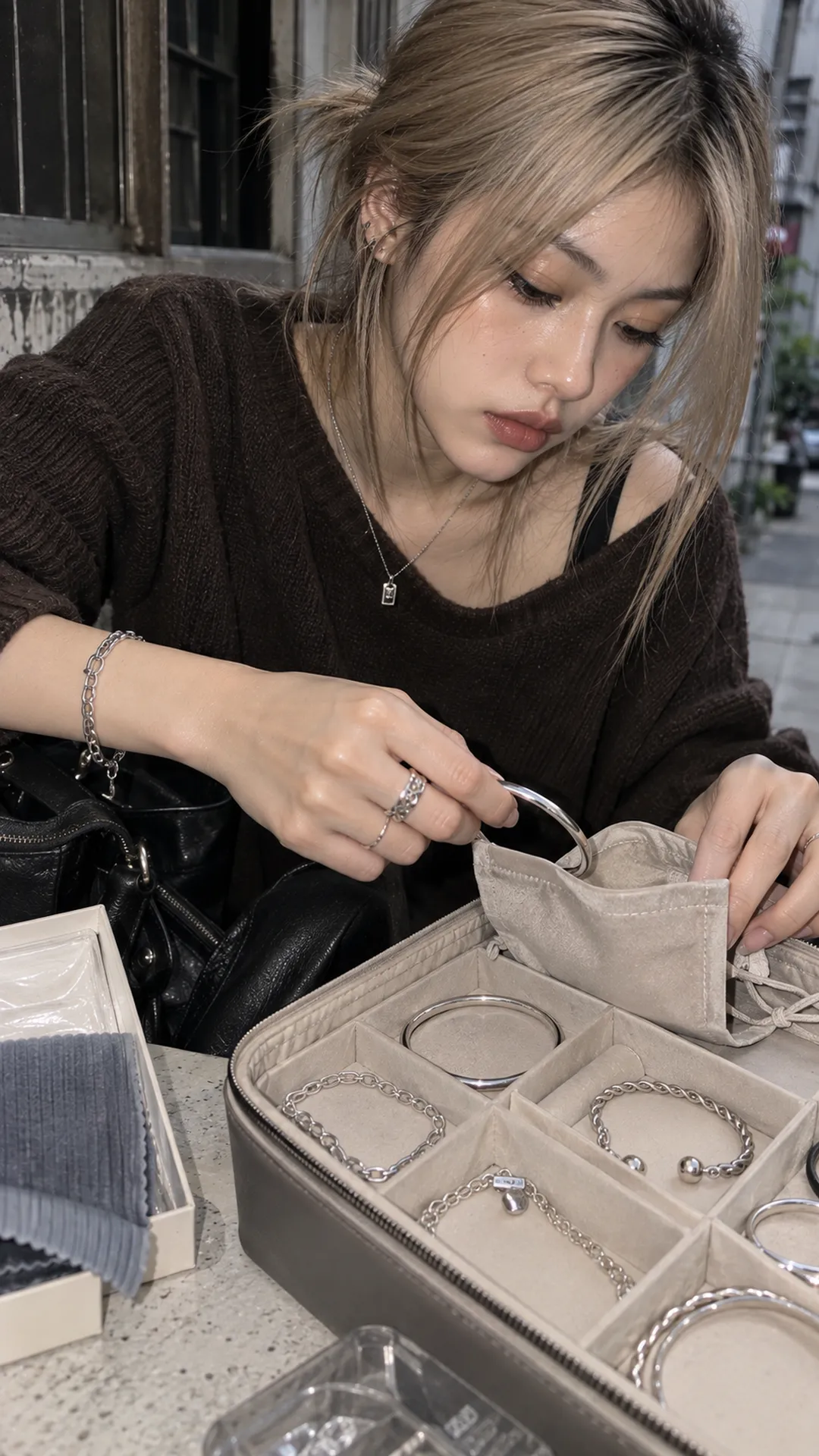
Mix silver and gold tones if you like. Let one cover more area and the other appear in a small accent. Assess the complete outfit with clothes and bag rather than judging only your hands under shop lighting.
Necklines, sleeves and garment shape all affect jewelry prominence. If a change of top suddenly makes your bracelet arrangement feel too busy, consult how to choose tops by fit and cut before abandoning the accessories.
Compare prices and plan care
The phrase 'women's silver bracelet' cannot establish a single price. Compare at the same time and establish material, disclosed weight, solid or hollow construction, plating, stones, workmanship and after-sales service. Similar-looking designs may differ in parts not visible in photos.
Ask three final questions: What does resizing cost? Can a broken clasp be repaired? How should this surface be cared for? Do not choose only for a low price before establishing exactly what kind of jewelry you are buying.
According to Tiffany, silver can tarnish; avoid harsh chemicals, store it dry and note that excessive polishing may remove an intentionally darkened finish. For plating or stones, follow the specific product instructions rather than applying plain-silver cleaning methods.
Before storing, inspect the clasp, connecting links and details for looseness. Separate storage makes pieces easier to retrieve and examine. If an edge breaks, the clasp will not hold or a stone moves, stop wearing the bracelet and have it checked for repair before using it again.