

What Is Scene Style? Bright Colors, Layered Hair and MySpace References
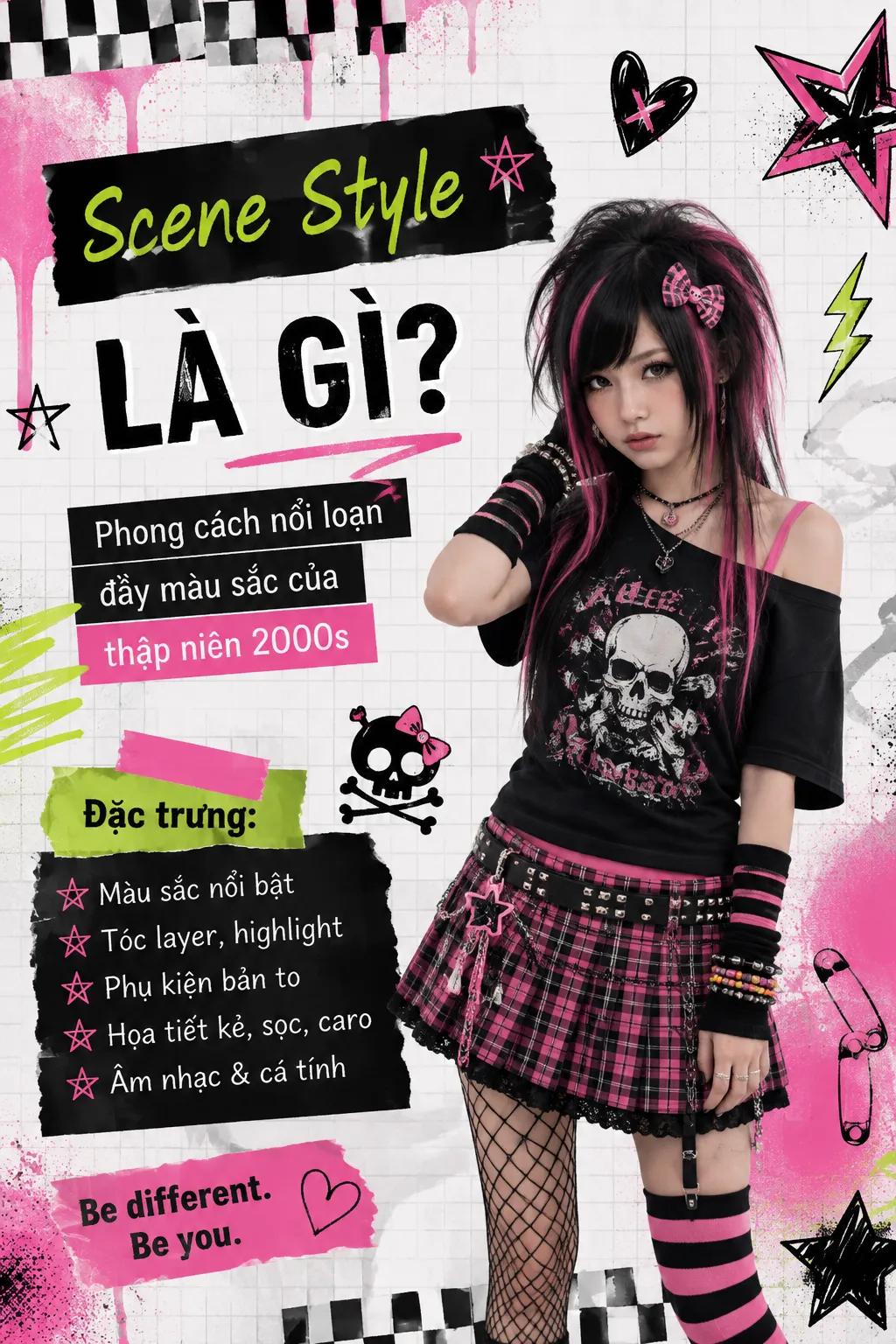
Scene Style is a subculture and fashion language closely associated with the early-to-mid-2000s internet, especially MySpace: voluminous layered hair, a side fringe, neon colors, graphic tees, skinny jeans, studded belts, and accessories designed to stand out in profile photos.
Scene and Emo overlap considerably, particularly in hair, band tees, and music communities. Scene generally pushes color, pattern, accessories, and the performative side of personal imagery further. Calling it “colorful Emo” is an accessible shortcut, but it misses part of the story.
In this guide: explains Scene Style, its visual codes, and contemporary outfit ideas. For a closer look at Emo, read What Is Emo Style?; for a later generation of internet aesthetics, see What Is E-Girl Style?.
Guide collection: E-Girl / Alt Girl: Guides, Outfits and Dark Y2K (Vietnamese)
Scene Style is more than neon and big hair. It is a visual language that developed alongside profile culture, band pages, and personal branding on MySpace.
What Is Scene Style?
Scene Style is associated with the scene subculture that grew during the 2000s, particularly through MySpace and alternative music communities. Its visual vocabulary includes voluminous choppy layers, a side fringe, bright hair or contrasting streaks, graphic or band tees, skinny jeans, neon colors, clashing patterns, studded belts, skate shoes, and layered accessories.
Scene places considerable emphasis on outgoing visual self-expression . An outfit was worn in person but also needed to read clearly in a small profile photo: a large hair silhouette, strong color contrast, recognizable graphics, and accessories that offered several points of interest.
That is why Scene is more than an item checklist. Its central ideas are visual density, playful contrast, and online self-presentation. You can dress with Scene influences without dyeing your entire head neon or precisely recreating a 2008 profile.
Where Did Scene Originate?
Scene developed in the early 2000s and became particularly visible in the middle and later years of that decade. It intersected with hardcore, post-hardcore, pop-punk, metalcore, deathcore, electronic music, and later crunkcore and rave-influenced sounds. As these communities used MySpace to discover bands, make friends, and build profiles, fashion developed alongside internet identity.
MySpace mattered for more than simply being a site Scene kids used. Customizable profiles, embedded music, photo albums, and band and fan networks shared the same page. Hair, nicknames, camera angles, color palettes, and profile layouts became an early system of personal branding.
Scene also changed over time. Early examples could sit closer to Emo or fashioncore; later looks often emphasized neon, rave references, Harajuku-inspired color, kandi, and party graphics. There was no single uniform covering every Scene community throughout the 2000s and 2010s.
Recognizing Scene Fashion
| Feature | Typical Scene expression | A contemporary approach |
|---|---|---|
| Color | Black base with neon, pink, green, blue, or purple | Keep a dark base and one or two strong accents |
| Top | Graphic tee, band tee, fitted tee, or zip hoodie | Make one large graphic the focal point |
| Bottom | Skinny jeans, colored denim, mini skirt, or shorts | Moderately baggy denim also works when hair, graphics, and accessories retain Scene references |
| Pattern | Stripes, checkerboard, zebra or leopard print, cartoon graphics | Choose one leading pattern rather than three equally prominent prints |
| Shoes | Converse, Vans, skate shoes, or lighter boots | Simple footwear balances a detailed upper half |
| Accessories | Studded belt, kandi or rubber bracelets, bows, large glasses | Concentrate detail in one area: hair, wrists, or belt |
| Hair | Choppy layers, teased crown, side fringe, extensions or streaks | Prioritize shape; color is optional |
Scene Does Not Require Head-to-Toe Neon
Black with hot pink, charcoal with lime, or black-and-white checkerboard with one hair-color accent can provide enough contrast. If a tee, belt, laces, bracelets, and hair all use neon at equal intensity, the outfit can lose its visual hierarchy.
Graphics and Patterns That Read Clearly on Screen
Scene often favors instantly recognizable images: large graphics, cartoon or pop-culture references, stripes, and animal prints. Give a strong graphic some space. A colorful tee can work with plain bottoms; patterned skinny jeans benefit from a simpler top.

Why Is Hair Almost a Scene “Logo”?
Scene hair is a particularly strong visual code because it reshapes the silhouette around the face. Choppy layers, a teased crown, a side-swept fringe, and longer straight lengths create a recognizable shape even with a simple outfit.
Color can amplify that effect: black with neon streaks, blonde with bright extensions, raccoon-tail stripes, or blocks of contrasting colors. However, shape matters more than color. Natural hair can still carry Scene influences through layers, volume, a side fringe, or carefully placed accessories.
If you prefer minimal styling, move the emphasis to graphics, bows or clips, bracelets, or a belt. Bleaching or dyeing your hair is not a requirement for wearing Scene Style.
How Does Scene Differ from Emo?
Scene and Emo share overlapping histories, music spaces, side fringes, band tees, skinny jeans, and eyeliner. The boundary is not always clear. In familiar late-2000s imagery, however, Scene often looks brighter, more maximal, and more focused on visual self-presentation.
| Feature | Scene | Emo |
|---|---|---|
| Palette | Dark base with neon or bright colors | Dark or muted colors with red and white accents |
| Hair | Large volume, multiple colors, and extensions | Side fringes and layers, often with darker colors |
| Accessories | Numerous playful plastic, kandi, or studded pieces | Often fewer, with an emphasis on bands, metal details, and belts |
| Visual mood | Flashy, playful, and ready for a profile photo | Often more restrained or introspective |
These are visual tendencies, not rigid rules about people or music taste. Read What Is Emo Style? for the Emo timeline and why reducing Emo to a black uniform is also an oversimplification.
How Does Scene Differ from E-Girl?
E-Girl is a later internet aesthetic shaped more by TikTok, Instagram, and gaming communities than MySpace. It can borrow from Scene, Emo, and Punk through graphic tees, plaid skirts, striped layers, chokers, chains, and colorful hair. Makeup, cropped silhouettes, and combinations of influences often vary more freely.
A useful distinction is context: Scene connects closely to MySpace-era subculture and identity, while E-Girl describes a later internet aesthetic mixing several influences. A single photograph can look similar without sharing the same background.
How Does Scene Differ from Y2K?
Y2K broadly describes fashion and imagery inspired by the late 1990s and early 2000s: metallic finishes, baby tees, low-rise trousers, glossy bags, denim, rhinestones, and futuristic pop. Scene is a more specific subcultural branch that became prominent in the mid-to-late 2000s, with distinctive hair, band and graphic culture, skinny silhouettes, and MySpace identity.
Both appear in contemporary 2000s nostalgia, so revivals often mix them. If an outfit emphasizes metallic finishes, baby tees, low-rise denim, and pop-star gloss, read Y2K Style (Vietnamese). A dark base with neon, teased hair, graphics, and studded details points more strongly toward Scene. For a darker interpretation, see Dark Y2K (Vietnamese).

Six Contemporary Scene-Inspired Outfit Formulas
1. Graphic Baby Tee, Moderately Baggy Jeans, and Hair Accessories
This updates the silhouette while retaining Scene references. The graphic provides a focal point, the jeans introduce a contemporary shape, and a clip, bow, or bracelet brings back Scene detail. Keep the sneakers relatively streamlined.
2. Black Graphic Tee, Plaid Mini, and Striped Tights
This combination sits near the Scene–E-Girl overlap. To strengthen the Scene influence, add color through hair or accessories instead of piling on chains. If the skirt is plaid, use a graphic with fewer colors.
3. Bright Skinny or Straight Denim, a Neutral Tee, and a Studded Belt
Colored denim brings a strong 2000s reference. When the bottoms are neon, a black or white top avoids competing with them. A studded belt or checkerboard shoes can provide enough finishing detail.
4. Zip Hoodie, Fitted Graphic Tee, and Denim
This is an accessible everyday option. A hoodie with a graphic or contrasting zipper, a fitted tee, and denim create a familiar foundation. Hair, a bow, or bracelets supply the Scene references.
5. A Dark Base with One Neon Area
Keep tops and bottoms black or gray, then choose one colorful area: hair, a belt with bracelets, or sneakers. This suits anyone who likes Scene without wanting a full rainbow palette.
6. Mini Skirt or Shorts, Leg Warmers or Striped Socks, and Sneakers
Leg warmers, patterned socks, or arm warmers can establish a strong visual rhythm. Use one prominent layer so the outfit remains manageable. For a closer look at mesh and alternative layering, see what to wear with mesh tops.
A Contemporary Scene Formula: Two Strong Signals and One Neutral Base
An easy starting point is to choose two Scene signals and give them a quieter foundation. Try graphics with hair, neon with a studded belt, or striped layers with stacked accessories. Black denim, a plain tee, or simple sneakers can form the base.
Are Scene and Scenecore the Same?
The terms are often used interchangeably online, but they are not always exact synonyms. Scene refers to the historical subculture of the 2000s and early 2010s. Scenecore is often used for newer revivals and internet interpretations that may emphasize neon, kandi, hyperpop or rave references, and digital nostalgia.
For historically inspired outfits, begin with Scene and MySpace archives. For a 2020s revival, Scenecore can allow a looser remix. They share color, hair, graphics, and maximal accessories without necessarily sharing the same context.
Six Common Scene Styling Mistakes
- Calling Scene “colorful Emo”: the shortcut misses MySpace, visual self-presentation, and maximalism.
- Making every area neon: the outfit loses its focal point. Adjustment: choose one or two strong color areas.
- Giving graphics, animal print, checks, and stripes equal emphasis: the patterns compete. Adjustment: choose one main pattern and supporting details.
- Trying to recreate all of 2008 at once: the result can feel like a costume. Adjustment: keep two strong signals and update the silhouette.
- Assuming hair must be bleached or dyed: hair shape and accessories can communicate Scene influences.
- Calling every colorful E-Girl outfit Scene: look at context, hair, palette, and the accessory system rather than one item.
Shopping for Scene: Search for Individual Pieces
Graphic tees, striped layers, colored denim, studded belts, sneakers, arm warmers, and hair accessories can be sourced separately. Buying components makes it easier to check fit, material, and versatility than purchasing a set labeled Scene that may function mainly as a costume.
With a small budget, prioritize a graphic or hair accessories first. These can change the overall impression more noticeably than several small hardware details.
Comparing Scene and E-Girl Through Outfit Examples
The three looks below are E-Girloutfits, rather than Scene examples. They illustrate overlapping features such as graphics, plaid, mini silhouettes, and color accents, while showing why those elements alone do not establish a Scene identity.
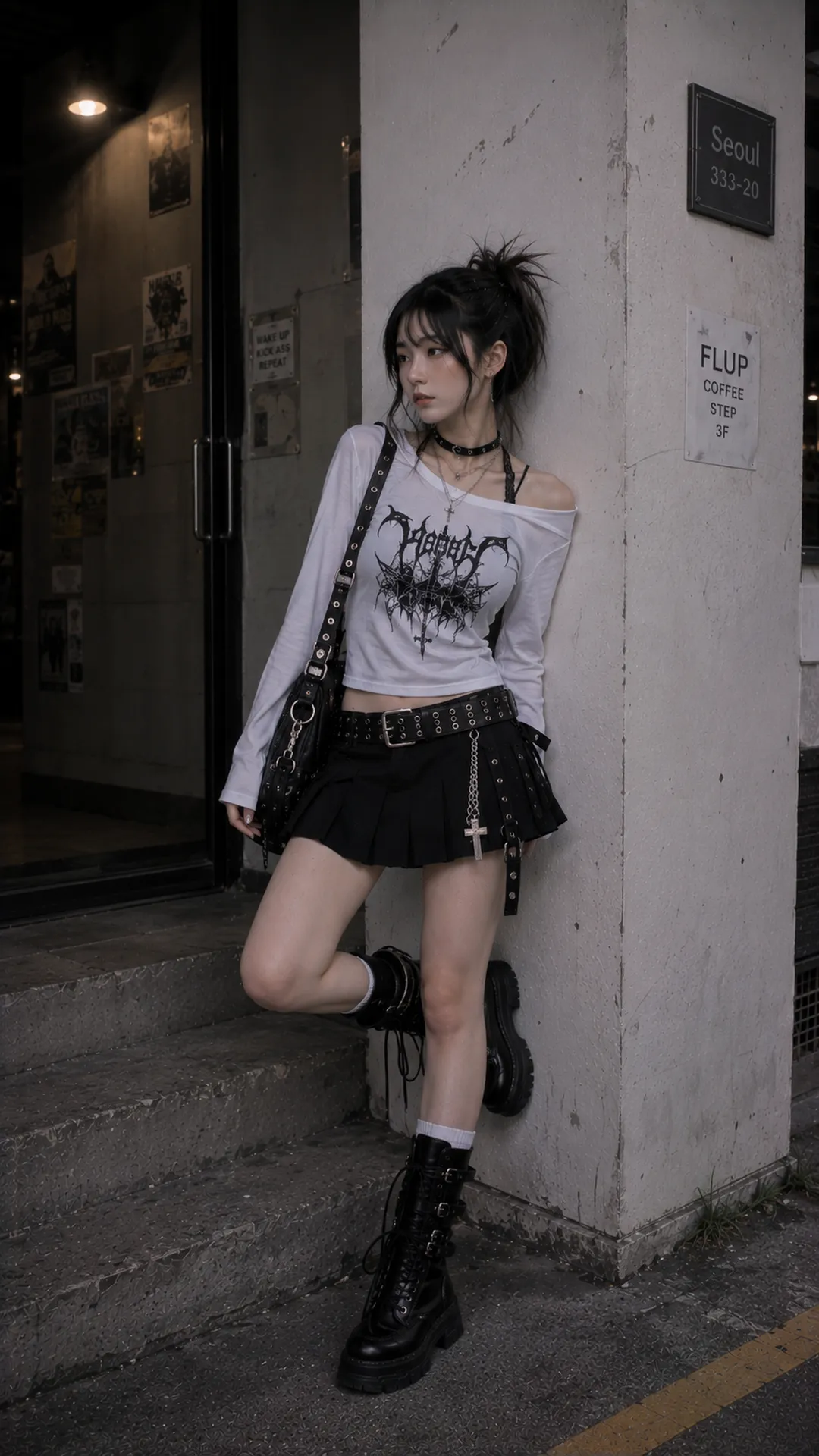
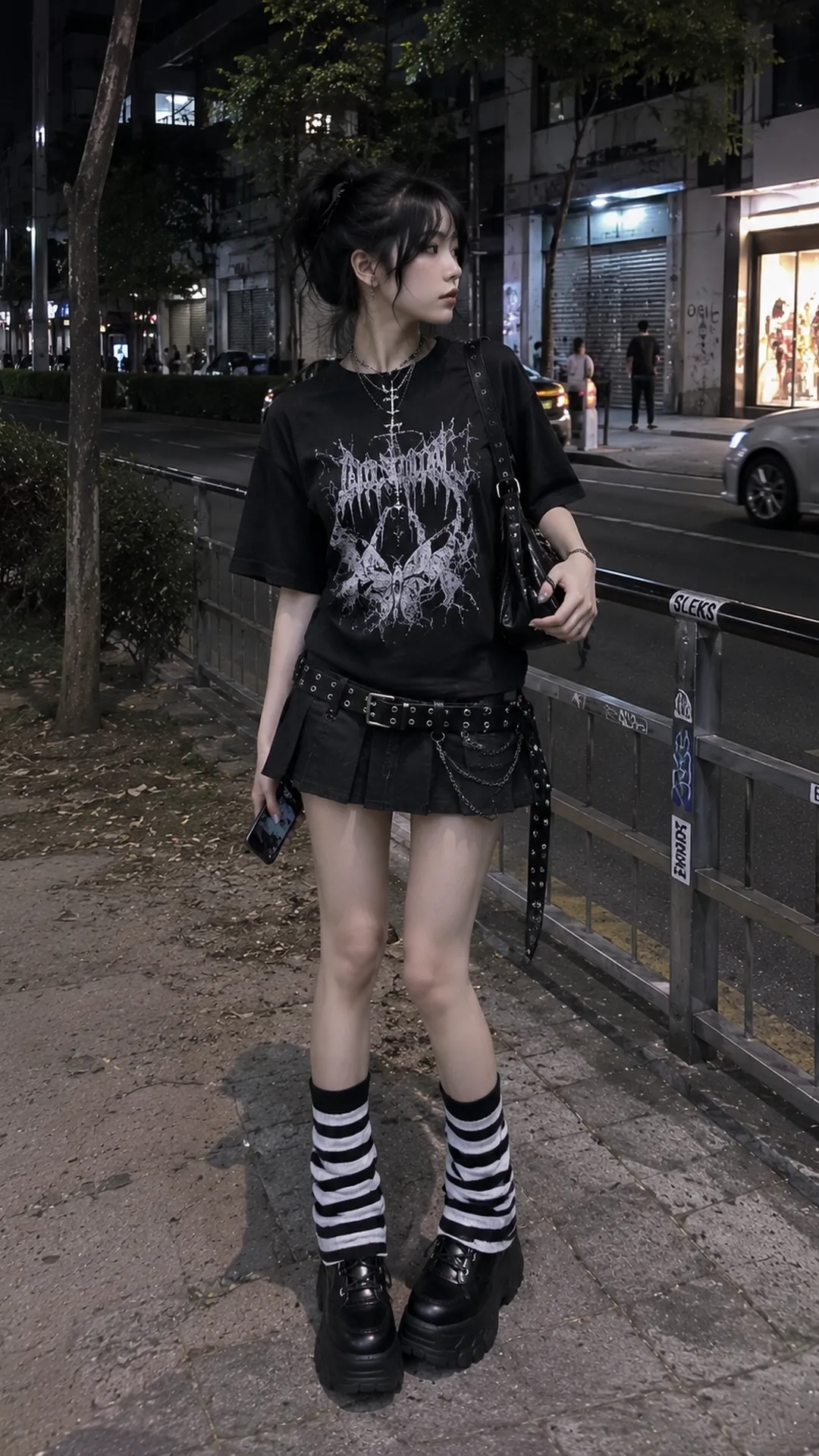
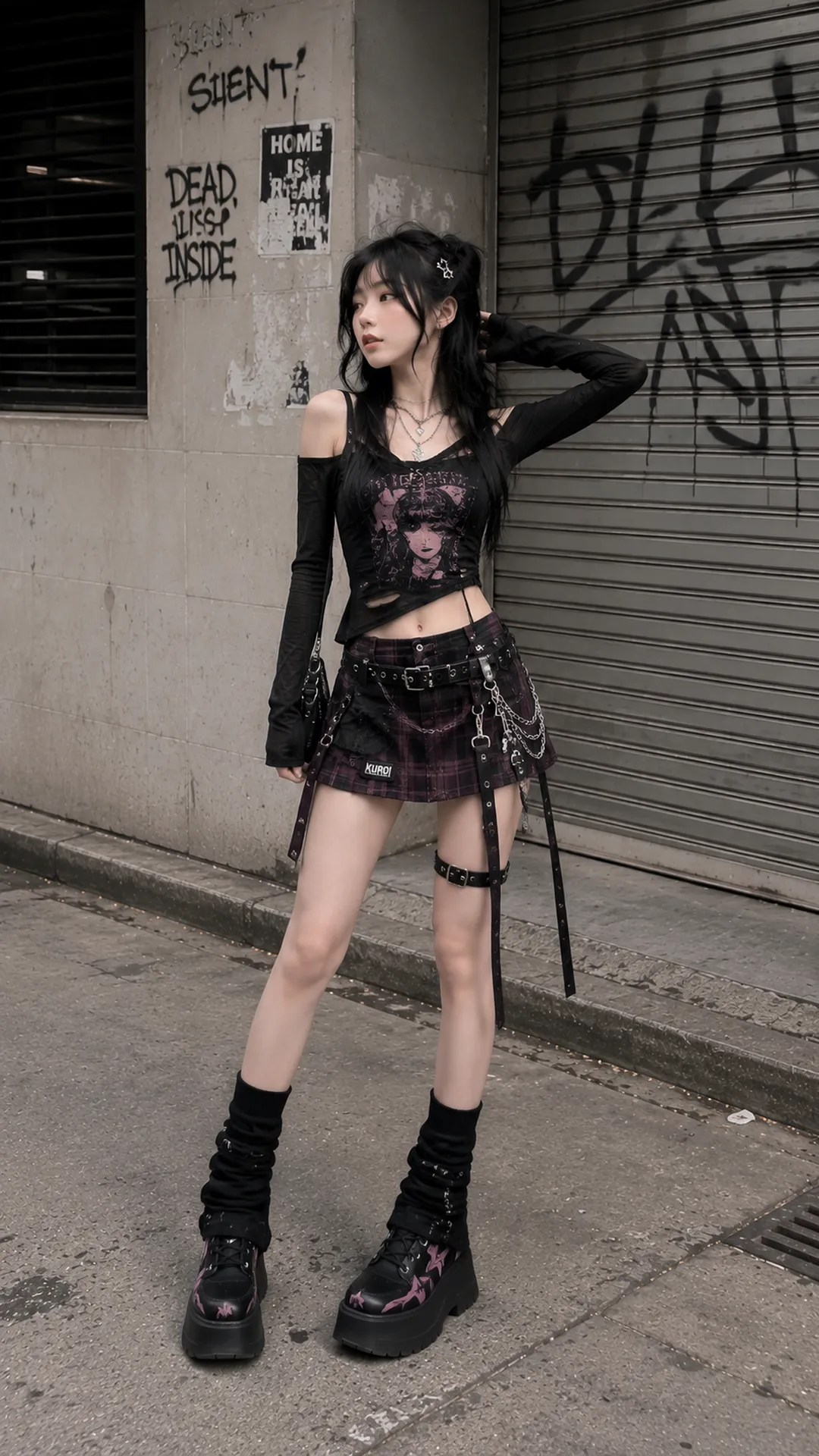
To move these looks toward Scene, consider hair volume or a side fringe, a clear bright-color hierarchy, a studded belt, stacked bracelets, or a deliberate pattern system. Renaming the aesthetic alone does not change the outfit.
Sources and Further Reading
The following sources provide context for Scene, MySpace, and the overlap with Emo:
- Vogue — What Comes After Y2K? — a Scene retrospective covering skinny jeans, fitted tees, pattern clashes, eyeliner, studded belts, and side-swept hair.
- Vogue — A History of Fashion and Beauty on Social Media — MySpace and its role in self-expression, music integration, and online identity.
- VICE — Late-2000s Scene Kid Context — music and Scene context during the MySpace era.
The contemporary outfit formulas are Apocalypse Closet editorial suggestions. The illustrated outfits have E-Girl characteristics and serve as comparisons rather than typical Scene examples.
Frequently Asked Questions
What is Scene Style?
Scene Style is associated with the 2000s scene subculture and MySpace culture. It often features large layered or teased hair, neon colors, graphic or band tees, skinny denim, studded belts, and layered accessories.
Is Scene the same as Emo?
Not exactly. They overlap in hair, band tees, skinny jeans, and music spaces. Familiar Scene imagery is often brighter, more maximal, and more profile-oriented, while Emo has its own music history and often darker imagery.
How does Scene differ from E-Girl?
E-Girl is a later internet aesthetic combining several alternative influences. Scene connects more directly with MySpace-era subculture, teased hair, bright-color hierarchy, and dense accessories.
Are Scene and Y2K the same?
No. Y2K is a broad fashion and nostalgia label for the late 1990s and early 2000s. Scene is a more specific subculture that became prominent in the mid-to-late 2000s, with distinctive hair, graphics, skinny silhouettes, and MySpace identity.
Can I wear Scene without dyeing my hair?
Yes. Choppy layers, a side fringe, or hair accessories can work alongside graphics, color accents, and studded details without bleaching or dyeing.
Do I need skinny jeans for a Scene outfit?
Contemporary outfits do not require them. Moderately baggy or straight denim can work when hair, graphics, color hierarchy, and accessories make the Scene references clear.